Prince George’s County Dog Registration Information
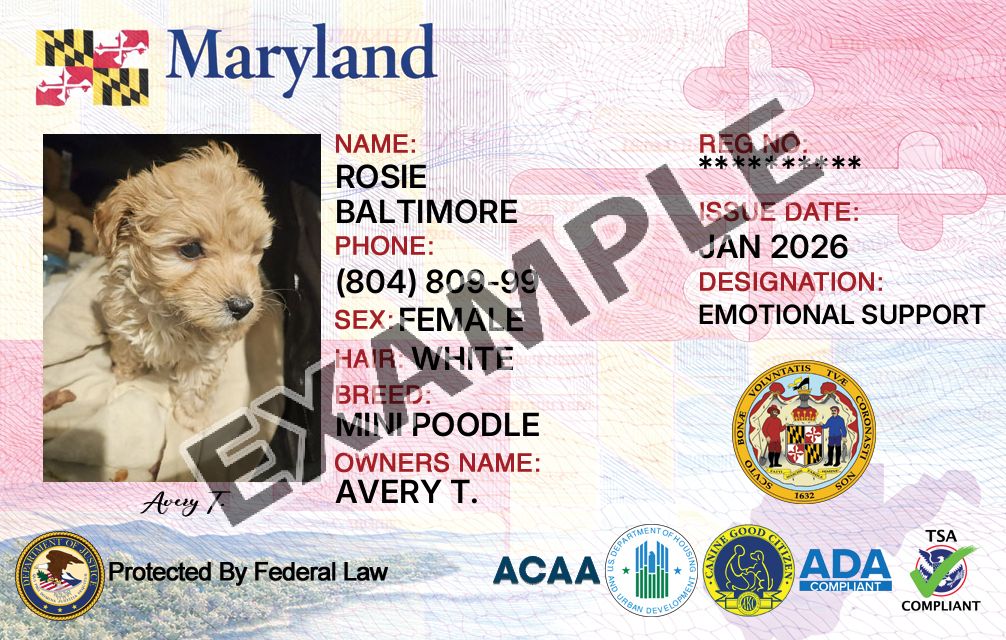
Service Dogs and Emotional Support Animals in Prince George’s, Maryland
If you’re asking where do I register my dog in Prince George’s County, Maryland for my service dog or emotional support dog, the key point is this: registration usually means a county pet license (often tied to rabies vaccination compliance), while a service dog or emotional support animal (ESA) status is a separate legal concept.
This page explains how to get a dog license in Prince George’s County, Maryland, which official offices handle licensing and animal control issues, and what changes (and what does not change) when your dog is a service animal or an ESA.
Where to Register or License Your Dog in Prince George’s County, Maryland
Because licensing is often handled at the county or city level, start with the county’s animal services program. If you live inside a city that provides its own animal control office, that office may also be an official place to ask about local requirements or enforcement. Below are examples of official offices within Prince George’s County, Maryland that residents commonly contact for animal control dog license Prince George’s County, Maryland questions and pet licensing help.
Prince George’s County Department of the Environment — Animal Services Division (Animal Services Facility & Adoption Center)
| Address | 3750 Brown Station Road, Upper Marlboro, MD 20772 |
|---|---|
| Phone | (301) 780-7200 |
| License help (assistance line) | (301) 780-7251 |
| Office hours | Not listed in the county sources used for this page. |
| Not listed in the county sources used for this page. |
Use this office for county animal services questions, including where to register a dog in Prince George’s County, Maryland and general licensing guidance.
Prince George’s County — County Services (Click 311)
| Phone | 311 or (301) 883-4748 |
|---|---|
| Address | Not listed (phone-based service). |
| Office hours | Not listed in the county sources used for this page. |
| Not listed in the county sources used for this page. |
Use 311 for non-emergency county service questions and to be routed to the appropriate department.
City of Bowie — Animal Control (within Prince George’s County)
| Address | 15901 Fred Robinson Way, Bowie, MD 20716 |
|---|---|
| Phone | (301) 809-3002 |
| Office hours | Not listed in the city source used for this page. |
| Not listed in the city source used for this page. |
If you live within Bowie’s city limits, this office can explain local enforcement and where to start for licensing and animal control questions.
Overview of Dog Licensing in Prince George’s County, Maryland
What “registering your dog” usually means
In everyday conversation, people often say “register my dog” when they actually mean getting a pet license. In Prince George’s County, local law requires dogs (and other covered pets) above a certain age to be licensed. A license is not a “certification” of training or behavior; it’s typically a local compliance requirement that helps the county track ownership and rabies vaccination compliance.
Who enforces licensing and animal control rules
Prince George’s County animal control and related animal services functions are handled through the county’s animal services program. If you’re trying to confirm animal control dog license Prince George’s County, Maryland requirements or where to apply, the county animal services office is the best starting point. For non-emergency routing and general county assistance, 311 can connect you to the appropriate department.
Age and general licensing obligation
County code provisions require a dog (as well as cats and ferrets) to be licensed once the pet reaches the required minimum age threshold (commonly referenced as four months for covered pets). If you’re unsure whether your dog is old enough to require a license, ask the county Animal Services Division using the phone numbers listed above.
Rabies vaccination is central to licensing
A current rabies vaccination is typically required as part of lawful pet ownership and is commonly required to obtain or renew a license. Keep your vaccination documentation from your veterinarian, including dates and the pet’s identifying information, because licensing and rabies enforcement often go hand-in-hand.
How Dog Licensing Works Locally in Prince George’s County, Maryland
Step-by-step: how to get a dog license in Prince George’s County, Maryland
- Confirm where you should apply. For most residents, the county Animal Services Division is the correct agency. If you live within a municipality that handles certain animal control functions locally, you can still start by calling the city animal control office or county animal services to confirm the correct process.
- Gather your documents. Most licensing workflows require proof of rabies vaccination. You should also be prepared to show identifying information and proof of local residency if requested.
- Apply and pay the licensing fee. Prince George’s County provides an official payment portal for individual animal license payments and publishes licensing materials through county animal services. If you need help with payment or license status, use the license assistance phone line listed in the office section.
- Keep your records and renew as needed. Licenses typically expire and require renewal. Store your license information and rabies paperwork together so you can quickly respond if you need proof for housing, travel, or after an incident (like a bite report).
Local vs. “online registration” confusion
Many owners searching for where to register a dog in Prince George’s County, Maryland run into unofficial “registration” offers online. In practice, your legal compliance usually comes from the local dog license issued through the county (or a city office if applicable). If you’re uncertain whether something is official, rely on county government offices and contact numbers rather than third-party websites.
Rabies enforcement and why it matters
Rabies vaccination rules are often enforced through licensing checks, veterinarian records, and animal control responses (such as bite investigations or quarantine requirements). Maintaining current rabies vaccination helps protect public health and can simplify the process if animal control ever needs to confirm your dog’s vaccination status.
Does service dog or ESA status change licensing?
In most cases, service dogs and emotional support animals still must follow local animal laws—such as leash rules, vaccination requirements, and licensing—just like other dogs. In other words, even if you’re searching for where do I register my dog in Prince George’s County, Maryland for my service dog or emotional support dog, the “registration” piece is usually the same local licensing process, while service-dog/ESA status relates to different laws and rights.
Service Dog Laws in Prince George’s County, Maryland
What legally makes a dog a service dog
A service dog is generally a dog that is individually trained to do work or perform tasks for a person with a disability. The emphasis is on trained tasks that directly relate to the disability (for example, guiding, alerting, retrieving, interrupting behaviors, or providing mobility support).
Service dog status is not the same as a county dog license
A dog license in Prince George’s County, Maryland is a local licensing requirement connected to pet ownership and public health compliance. A service dog’s legal status is based on disability law concepts and training—not on a county-issued “service dog registration.” You may need both: (1) the county license for lawful ownership locally, and (2) the dog’s training and handling consistent with service dog requirements.
What you can be asked in public settings
In many public-access situations, staff generally cannot demand medical documentation. They may be limited to asking if the dog is required because of a disability and what work or task the dog has been trained to perform. Regardless of service dog status, handlers are expected to maintain control of the dog and follow applicable safety rules.
Service dogs and local animal control rules
A service dog still must follow local laws like licensing, vaccination, and animal-at-large rules. If an incident occurs (such as a bite complaint), animal control may still investigate and may still require proof of rabies vaccination and ownership details.
Emotional Support Animal Rules in Prince George’s County, Maryland
What an emotional support animal (ESA) is
An emotional support animal helps a person with a disability through companionship and emotional support. Unlike service dogs, ESAs are not defined by being trained to perform specific tasks for a disability in the same way service dogs are.
ESA status does not equal public-access rights
ESAs are commonly associated with certain housing-related accommodations when supported by appropriate documentation, but ESAs generally do not have the same public-access permissions as service dogs. That means an ESA may not be allowed in places where pets are prohibited, unless another law or policy provides access.
ESA + licensing: what stays the same
If your dog is an ESA, you still generally need to meet local requirements such as a dog license in Prince George’s County, Maryland and up-to-date rabies vaccination. If you’re trying to determine where to register a dog in Prince George’s County, Maryland as an ESA, the “registering” step is typically the same local licensing process through official county offices.
Avoid confusing ESA letters with local licensing
An ESA letter or healthcare documentation (when applicable) is separate from county pet licensing. The county license is about compliance with local animal laws; ESA documentation is about accommodation needs in specific contexts (most often housing).
Frequently Asked Questions
For most residents, “registering” means obtaining a dog license in Prince George’s County, Maryland through the county’s Animal Services Division. Start with the county Animal Services Facility & Adoption Center and ask for the pet licensing process. If you live inside a municipality (such as Bowie), you can also contact that city’s animal control office to confirm local procedures and enforcement boundaries.
In most situations, yes—service dogs still must comply with local licensing and vaccination requirements. Service dog status relates to disability law and trained tasks, while a county dog license is a local legal requirement tied to ownership, identification, and rabies compliance.
Typically, no. An ESA may be supported by documentation for certain accommodations (commonly housing), but that is separate from county licensing. For local compliance, you generally still obtain the same animal control dog license Prince George’s County, Maryland residents use for any dog.
You should expect to provide proof of rabies vaccination and pay a licensing fee. Additional requirements can vary (for example, proof of residency). If you want to avoid delays, call the county licensing assistance line first and ask exactly which documents are required for your situation.
Call 311 (or the county’s alternate 311 number) for non-emergency routing, or contact the county Animal Services Division directly. This is often the fastest way to confirm where to register a dog in Prince George’s County, Maryland based on your specific address.
Disclaimer: Licensing requirements and office locations may change. Residents should verify details with their local animal services office within Prince George’s County, Maryland.
What You May Need
- rabies vaccination proof
- identification
- proof of residency
- licensing fee
Quick Clarity: License vs. Service Dog vs. ESA
Dog license (local)
A local requirement for many dogs living in the county. It often relates to identification and rabies vaccination compliance.
Service dog (legal status)
A dog trained to perform tasks for a person with a disability. Service dog status is not created by buying a “registration,” and it does not replace local licensing requirements.
Emotional support animal (ESA)
Provides emotional support that helps with a disability. ESA status is typically relevant to accommodation contexts (commonly housing), but it does not automatically grant public access like a service dog.
Register A Dog In Other Maryland Counties
Select your county below to get started with your dog’s ID card. Requirements and license designs may vary by county, so choose your location to see the correct options and complete your pup’s registration.
- Allegany County Dog Registration
- Anne Arundel County Dog Registration
- Calvert County Dog Registration
- Caroline County Dog Registration
- Carroll County Dog Registration
- Cecil County Dog Registration
- Charles County Dog Registration
- Dorchester County Dog Registration
- Frederick County Dog Registration
- Garrett County Dog Registration
- Harford County Dog Registration
- Howard County Dog Registration
- Kent County Dog Registration
- Montgomery County Dog Registration
- Queen Anne’s County Dog Registration
- Somerset County Dog Registration
- St. Mary’s County Dog Registration
- Talbot County Dog Registration
- Washington County Dog Registration
- Wicomico County Dog Registration
- Worcester County Dog Registration